
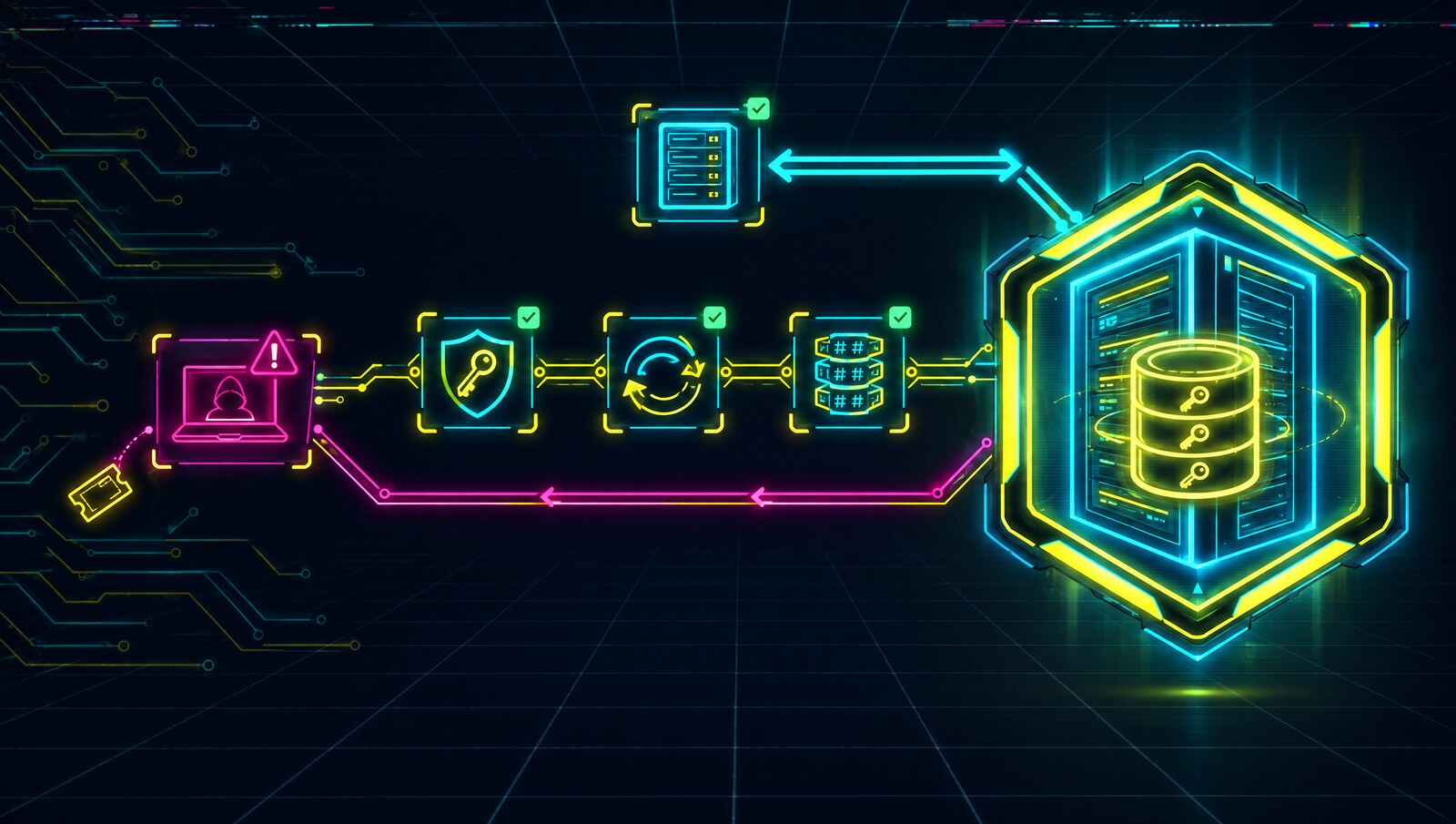
Ok so what is DCSYNC, I mean it isn’t really a new thing in 2026, however it is still worth understanding as iy still happens today within an Active Directory environment.
Essentially we are taking advantage of permissions that allow directory data to be replicated between domain controllers. That data lives in NTDS.dit, the data store that holds accounts within active directory, password hashes included. The file itself never leaves the DC; the attacker asks a DC to replicate the data to them. Getting access to this means an attacker can crack hashes offline or even repurpose them to generate a golden ticket.
Ok lets quickly check that, Golden Ticket, a forged ticket that acts as a persistence within the environment, where the user of the ticket is free to roam and laterally move as the environment thinks the forged ticket is good. This works with any member attached to the domain and where trust exists.
A DCSYNC allows the user to make a call with the DRSUAPI to the DC and get a copy of the data. Tools such as Mimikatz, DSInternals, and Impacket can do this, but we want to look out for behaviour than the tool name. A renamed binary still needs the replication service and sufficient directory rights.

This attack is powerful because the domain controller treats the source as authorised.
DCSync commonly depends on two replication extended rights. Include the filtered-set right when you audit delegations because it expands what a principal can replicate in relevant configurations.
| Extended right | Rights GUID | Why it matters |
|---|---|---|
| Replicating Directory Changes | 1131f6aa-9c07-11d1-f79f-00c04fc2dcd2 | Allows replication of changes from a naming context |
| Replicating Directory Changes All | 1131f6ad-9c07-11d1-f79f-00c04fc2dcd2 | Allows replication of secret domain data |
| Replicating Directory Changes In Filtered Set | 89e95b76-444d-4c62-991a-0facbeda640c | Allows replication of attributes in the filtered set |
Domain controllers need replication rights. Some synchronisation and identity-management services may also have an approved business reason. A user or service account holding these rights may not be proof of compromise. If a non-DC account has them, I want to know who owns it, why it needs them and when somebody last checked. Essentially Life Cycle Management principles.
Hunting for Bad bad
Event 4662 records an operation on an Active Directory object. It only appears with Directory Service Access auditing enabled and the relevant system access control lists configured.
Do not wait for an incident to discover that the policy exists on paper but the events do not reach the SIEM. Generate an authorised validation event in a test domain or through your detection-testing process, then confirm the complete path from the domain controller to the analyst’s query.
Filter Event 4662 for replication rights
Start with successful 4662 events where `AccessMask` is `0x100` for Control Access and the properties contain a replication-right GUID. Microsoft describes 4662 as an object-operation event, so shipping every instance without filtering will create a great deal of noise.
The detection logic:
WHEN Security Event 4662 is Audit SuccessAND AccessMask is 0x100AND Properties contains a replication-right GUIDAND the subject is not an approved replication identityTHEN correlate the event with replication traffic from a source outside the known DC list
This is deliberately not a copy-and-paste SIEM query. Field names and GUID formatting differ across collectors, and Event 4662 does not give every platform the client context you need in one neat record. An Audit Failure with the same right records an attempted operation, not proof that replication succeeded.
Things to look for
A subject name that does not end in `$` is a clue because domain-controller computer accounts (in machine objects in general) normally end this way. It is not a complete rule. Legitimate service accounts can hold replication rights, and an attacker may compromise a computer account. (I will write up privileged access with a machine account at some point:) )
Maintain an approved list of replication principals and alert on changes to it. The difficult but valuable question is not “is this a user account?” It is “should this identity, use this right, from this source, at this time?” Visibility of objects is critical.
Another option is referenced from MITRE’s current DCSync detection strategy pairs Event 4662 with Directory Replication Service traffic. So we are looking for anomalous sources (by set than strictly IP address and actual replication traffic on the wire.
If a DCSync attack is successful then you will be looking at resetting passwords and krbtgt x2 at a minimum. This does not take into account further forensic analysis, but with this analysis you may find other issues that you may wish to remedy. For example there may be permissions in the directory that have been changed, new objects, or worse if say DPAPI keys have been stolen, but the DCSync by itself does not do this, it is a precursor just keep that in mind 🙂
Sources and further reading
The technique
- OS Credential Dumping: DCSync, Sub-technique T1003.006 — MITRE ATT&CK. Describes the abuse of the Directory Replication Service
- Detection of Unauthorized DCSync Operations via Replication API Abuse (DET0594) — MITRE ATT&CK. Combines Event 4662 with DRSUAPI network traffic and a known-domain-controller baseline
Microsoft documentation
- 4662(S, F) An operation was performed on an object — Microsoft Learn. Explains the audit and SACL requirements
- DS-Replication-Get-Changes extended right — Microsoft Learn. Official GUID definition for Replicating Directory Changes
- DS-Replication-Get-Changes-All extended right — Microsoft Learn. Official GUID definition for Replicating Directory Changes All
- DS-Replication-Get-Changes-In-Filtered-Set extended right — Microsoft Learn. Official GUID definition for Replicating Directory Changes In Filtered Set
- AD Forest Recovery – Reset the krbtgt password — Microsoft Learn. Explains the two resets and the waiting interval